Showing posts with label user experience. Show all posts

Monday, October 11, 2010

Persuasion - one of the qualities of a designer


As a designer, our role is to convey the message using the most suitable medium. Medium may not be perfect, but it at least eases the task of end user to perceive the message. And as a designer though our prime focus is on end user, skipping needs and greeds of stakeholders may bring havoc. So how do you handle those situations wherein what you anticipated, rather inferred from research and user studies doesn't sound good to stakeholders. They don't see the value and you are sure that it is the correct way.
You have to persuade them. Either being nice and polite or strict showing consequences. And what type of consequences? You might think of terminating the project and vowing not to work with such clients anymore. But take a pause and think where the problem is. Most of the time its communication gap. They assume that you'll assume the same thing they assumed ! Stumped.
But literally they always think that the product is going to take the form they have assumed cause, they have been talking to you. As a designer you should have the skills and capability of taking out the unsaid from the mind of your stakeholders/users. They can't perceive or see what you can and its true vice versa too.
So based on my experience, I would say be persuasive in nature. Provide enough evidence. Statistics might not make sense but a story would. And this soft skill will not only help your professional life, but a personal one too.

Thursday, October 07, 2010

Human pattern

Image from : http://www.echostudiochicago.com/sustainability/window-on-the-world

Remember as a child we always wanted to take up that window seat be it travelling in bus, train, car or even at home. We used to love to sit at window. But we never noticed this behavior pattern. Today while going through a presentation on Search and Discovery pattern I came across following,

Window Place: Everybody loves window seats, bay windows, and big windows with low sills and comfortable chairs drawn upto them. - Christopher Alexander in Pattern Language

So here is my take on the design aspect of this pattern.
Psychologically human feel comfortable in peeking outside their small world. They don't want to get confined in that small space. However they don't want to plunge too in that big world. Small world is cozy and comfortable for them. A window provides them a way to be in their comforts and still take a look at the big world around.
You Interface should be something similar to this. User don't want to get into the large world. They need comfort and coziness. However they want to browse through the information. As a designer we should be presenting the complex information to user the way they see world from their window.

Tuesday, October 05, 2010

Design Experience or Design FOR Experience - 1

User Experience Design. This 3 word title looks sounds great. Ask any designer and they'll say this is what they want to do or be.
It all started with Industrial design in the beginning. Then it was Human Factors Design (HFI) where users' interaction with the machine - the actual physical machine with all those levers, pulleys, switches and meters were studied. Then with introduction of digital media and technology it bifurcated into Human Computer Interaction (HCI) and Interaction Design. Designers now specialized in how user interacts with virtual objects constrained in one small screen. All those files, folders, Desktop and blah blah came into existence. With the advancement of technology this tiny little space got more power and technologists started putting more and more stuff in it. It became really hard for an end user to perceive what is inside and to conceive their task effectively. It wasn't race against time, it was more about not confusing the user. For the user of the system its like a maze wherein they have to anticipate what can come next. This cannot be left on mere guess work. Oh I started preaching design.
Coming back to actuals. Now the media and technology and so Information consumption is not just limited to one device/media/platform. You get same information in different format on different devices. Television, Computer - PC/laptop, Mobile phone and now Fridge, Washing machine, audio deck in car. And if all start delivering different interfaces to the user, there'll be no reason for him/her to continue using a service.
There comes the experience. As a designer we are responsible for designing experience of end user. But wait. We don't design experience because it largely depends on context, user and the goal and it is very dynamic. However we can design small artefacts to enhance the experience of user.

So it is designing for experience.

This post was more about arriving at the distinction. Next post will talk more about how do we Design for experience of users.

Monday, April 26, 2010

We should play games

I am a huge fan of computer based games. Not that I don't play outdoors, but with time I have embraced computer games as my favorite pass time. Playing with my kid is lot more fun and enriching, but computer games give me direction in which our future interaction with computers is heading. More and more devices and software and in the core information are becoming tangible and graspable. Future lies in having a system where you can easily sense the appropriate information of the context you are in. And when I say computer based games, they are not just limited to screens. Nintendo Wii is an excellent example of out of screen games, which is marvelous combination of physical and virtual environment. So are Sony's gesture based game control and the latest in news is project Natal by Microsoft. Natal is an excellent example of how gaming is taken a step further to take advantage of computational power to utilize virtual information in a tangible manner.
Project Natal by Microsoft

Nintendo Wii game setup

Take for example Google maps open on a mobile device. If you open google maps on any mobile and tag your current location it'll automatically zoom to your current location and show information around you. May be based on your previous searches it shows sequential information. If you have been searching for restaurants in past on your laptop/pc and/or mobile on google maps, next time you do a search on your mobile it may/will automatically provide you with restaurants information around you. So you are in a game.


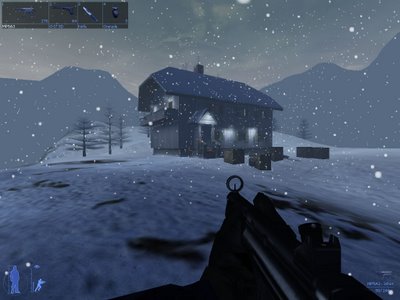
Project IGI game screenshots

A game is nothing but consumption of information in a context which is realistic. I have been playing project IGI. It's a third person, strategy based, shooter game. Information in there, is real like a physical world. You don't have dashboard or graphs or table to play with. you have actual physical objects. And once you are in game you will just play it rather than figuring out what's what? It's quite natural. Just see how lot of information weather, life of soldier, ammunition available, light conditions, time of day etc. can be easily figured out just by looking at the screen. It's real and natural.

If we take scenario of enterprise applications there has been lot of efforts in bringing the complexity of UI down to natural usage and very small amount of time investment to learn them. One way to achieve this is to create a game like scenario and then let the users (system admins, CEO etc.) play with the tangible information about outside world in the same fashion. Challenge is to figure out a way to represent the complex virtual information and relations between them in more natural way. Hence comes data visualization and mapping part of Design. It's altogether a separate topic in itself.

So in a nutshell if you want to learn UI design concepts you better be playing games !

Happy Gaming
Thursday, June 18, 2009

Transmedia storytelling and India


Though this term might have been there from some time, I recently discovered it.
Transmedia storytelling as wikipedia says is storytelling across multiple forms of media. This is very new take in industry where they try to split the entire User Experience across multiple media and services. Different sites have been citing different examples to simply understanding this term.
Wikipedia gives examples of Matrix and Batman begins movies where they have tried to put some of the storyline/part into comic books and games to know/understand the content better.

Indian version of this can be cited in movie Krish, where they manufactured toys and props of the movie and sold it. But if you notice we have been doing transmedia storytelling since ages and its not new to India or Indian business. Take for example Ramayan. It there on TV, in comics, on everybodys mind. Though it was limited due to limitations of digital and print media.
So what is the point that I am trying to make here?
It clear. There is lot of opportunities for India to take a deep dive into transmedia storytelling industry and generate revenue. This will not only create employment but also take care of thrusting the product across different stratas of society.

I was just thinking if this can be linked to ultimate User Experience, where its no more limited to the duration of using/consuming the product/service but through out the lifetime.
And if you have some brilliant idea just enter Transmedia storytelling competition

Friday, November 14, 2008

Design (for) User Experience

Well what have been misinterpreted so far even in design community comes to my notice while watching a session by Daniel Makoski. Daniel is User Experience Designer at Microsoft and a part of MS surface team. He pointed out that Liz Sanders defied the term User Experience Design.
You cannot design an Experience. You can only design FOR Experience.

Well she also defined experience in very good way. Liz says
experience is a point where users memory and dreams coincide

Well good enough. So now onwards we won't say User Experience Design but Design for (better) User Experience.